A pro rata calculator helps you find the proportional share of an amount based on how many units apply to your situation compared to the total.
Enter the full amount, the total number of units, and the number of units that belong to your share. The calculator applies the proportion and returns your pro rata amount along with the percentage it represents.
What Does Pro Rata Mean?
Pro rata means in proportion.
When an amount covers a set number of units, pro rata determines how much of that amount corresponds to a smaller portion of those units.
If a total amount of $1,000 covers 20 units and your share is 5 units:
5 ÷ 20 = 25%
$1,000 × 25% = $250
Your pro rata amount is $250.
The same logic applies across different situations — rent, salary, insurance, bonuses, and any other amount that can be divided according to a measurable share.
How the Pro Rata Calculator Works
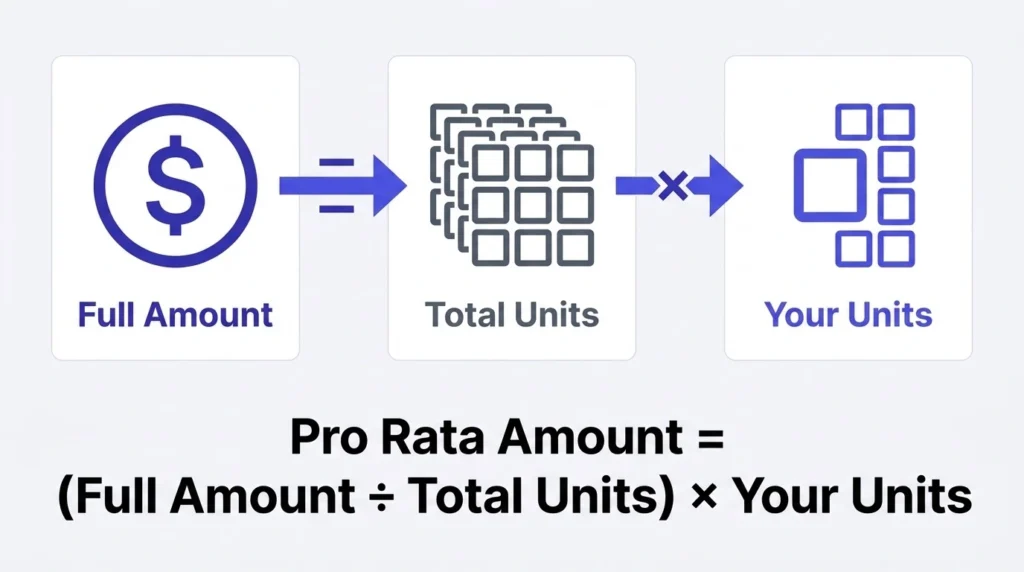
The calculation relies on three values:
Full Amount — the complete amount before any proportion is applied.
Total Units — the total quantity the full amount is based on.
Your Units — the quantity that applies to your specific situation.
These three values determine your proportional share.
Example:
Full Amount: $2,400
Total Units: 12
Your Units: 4
$2,400 ÷ 12 = $200 per unit
$200 × 4 = $800
Your pro rata amount is $800.
Pro Rata Formula
The standard formula is:
Pro Rata Amount = (Full Amount ÷ Total Units) × Your Units
To find the percentage your units represent:
Pro Rata Percentage = (Your Units ÷ Total Units) × 100
For example, if your units are 6 out of 24:
6 ÷ 24 × 100 = 25%
If the full amount is $800:
$800 × 25% = $200
Your pro rata amount is $200.
How to Use the Pro Rata Calculator
Step 1 — Enter the Full Amount
Enter the complete amount you want to divide proportionally. This represents 100% of the calculation.
Step 2 — Enter the Total Units
Enter the total number of units the full amount is based on. This could be days, hours, weeks, months, shares, or any other consistent unit of measurement.
Step 3 — Enter Your Units
Enter the number of units that apply to your share. This must use the same unit type as the total.
Step 4 — Select the Unit Type
Choose or enter the type of unit you are working with so the result is clearly labelled.
Step 5 — Select Your Currency
Select the currency for the result. The currency does not affect the calculation — it only changes how the result is displayed.
Step 6 — Calculate
Select the Calculate button. The calculator returns your pro rata amount, the percentage your units represent, and a step-by-step breakdown of the calculation.
Pro Rata Calculation Examples
Example 1
Full Amount: $1,500
Total Units: 30
Your Units: 18
$1,500 ÷ 30 × 18 = $900
Pro rata percentage: 18 ÷ 30 × 100 = 60%
Your pro rata amount is $900, which represents 60% of the full amount.
Example 2
Full Amount: $2,000
Total Units: 40
Your Units: 15
$2,000 ÷ 40 = $50 per unit
$50 × 15 = $750
Pro rata percentage: 15 ÷ 40 × 100 = 37.5%
Your pro rata amount is $750, which is 37.5% of $2,000.
What Can Be Used as a Unit?
A unit is simply a consistent way of measuring the total and your share. Common examples include days, hours, weeks, months, shares, or any other quantity that applies to your situation.
The important rule is that the total units and your units must use the same measurement. Mixing hours with days, for example, would produce an incorrect result.
Different situations call for different units. A pro rata salary is usually based on days or hours worked. A pro rata bonus is often based on months worked in the year. A pro rata settlement or pro rata share may be based on ownership units or agreed terms. Whatever the unit, the same formula applies as long as the total and your share are measured consistently.
Common Mistakes to Avoid
Using different units for total and your share
Both values must represent the same type of unit. Convert to a common basis first if they differ.
Entering a partial amount as the full amount
The full amount should represent the complete value — 100% of the calculation. If it has already been reduced, the result will not reflect the correct proportion.
Reversing the numbers
The formula is Full Amount ÷ Total Units × Your Units — not the other way around.
Assuming the result applies in all situations
A pro rata calculator gives a mathematical result based on the values entered. Some contracts, payroll systems, or billing arrangements follow their own conventions. If a specific agreement defines how the calculation should be performed, check those terms before relying on a calculated figure.
Frequently Asked Questions
What is a pro rata calculator?
A pro rata calculator determines the proportional share of a full amount based on the total number of units and the number of units that apply to your situation.
What is the pro rata formula?
Pro Rata Amount = (Full Amount ÷ Total Units) × Your Units
How do I calculate my pro rata percentage?
Divide your units by the total units and multiply by 100.
(Your Units ÷ Total Units) × 100
Can I use this calculator for different types of units?
Yes. The calculator works with any consistent unit — days, hours, weeks, months, shares, or other measurable quantities. For situations with a fixed unit type, you can also use a more specific tool such as the pro rata days calculator, the pro rata hourly rate calculator, or the pro rata vacation calculator.
What if my units equal the total units?
Your share is 100%, so the pro rata amount equals the full amount.
Can the pro rata percentage be less than 1%?
Yes. If your units represent a very small portion of the total, the percentage can be less than 1%.
Does the currency affect the calculation?
No. The currency selection only changes how the result is displayed. The calculation itself is independent of currency.
Important Note
This calculator provides a mathematical result based on the values you enter. Real-world calculations may be subject to additional terms, rounding conventions, or contractual conditions. If a specific agreement or official method applies to your situation, use that method when determining the final amount.